
The Prototype Secret: How to Test Your Medical Designs Before Going Big

Prototyping is a critical phase for identifying structural weaknesses and material inconsistencies before moving into high-volume medical apparel production.
Scaling medical designs from a single, hand-sewn sample to a 10,000-unit production run is the most dangerous phase for any apparel brand. A design that looks perfect on a mannequin can quickly fall apart—both literally and financially—when subjected to the pressures of high-volume manufacturing. To maintain quality at scale, you have to move beyond "aesthetic design" and embrace "designing for manufacturability" (DFM).
The Material Sourcing Pitfall
One of the most common mistakes in early-stage development is falling in love with a fabric that cannot be sourced consistently or at a viable price point for mass production. In the medical sector, textiles must meet rigid standards for fluid resistance, antimicrobial efficacy, and industrial launderability.
A prototype serves as your first real-world stress test. If your chosen material shrinks excessively at high temperatures or pills after three washes, it’s better to discover that during a five-unit sample run than after a massive shipment arrives. Testing the fabric’s interaction with seams and hardware is the only way to ensure the final product remains professional and functional through hundreds of shifts.
Designing for Manufacturability (DFM)
DFM is the secret to maintaining a high return on investment. It involves simplifying the construction of a garment to minimize waste and reduce assembly time without compromising the clinical utility. For instance, a complex pocket design might look great, but if it adds three minutes to the assembly of every garment, it could cost you thousands of dollars in labor over a large run.
When we look at successful office uniforms designed by Fort Worth businesses, we see a trend toward streamlined silhouettes that prioritize ease of movement. By optimizing the pattern during the prototyping phase, you can identify "stress points"—areas like the underarm or crotch where the fabric is likely to tear—and reinforce them before they become a widespread defect in your inventory.
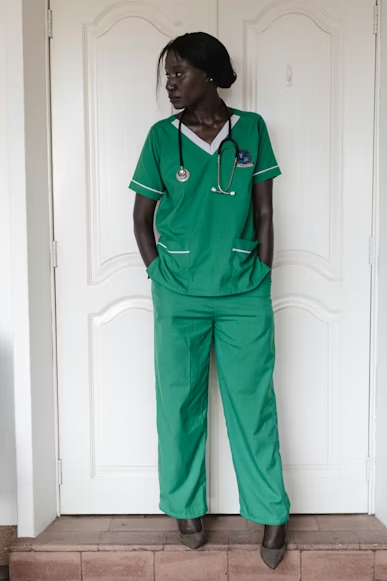
Applying "designing for manufacturability" principles during the sample stage ensures that large-scale production runs remain cost-effective and clinically reliable.
Scaling Quality Without the Friction
Many office uniforms designed by Fort Worth businesses lose their brand identity when they transition to offshore, high-volume factories. The "human touch" often disappears when a design is interpreted by a team that wasn't involved in the development phase. Keeping production closer to home allows for iterative testing that protects the integrity of the original vision.
We have found that custom healthcare uniforms in Fort Worth, manufactured by Stitch Texas, benefit significantly from this localized oversight. When the design team and the production floor are in constant communication, the lessons learned during the prototype phase are directly applied to the assembly line. This ensures that the 10,000th unit is just as precise as the first.
Investing in a rigorous prototyping process isn't an added expense; it is an insurance policy. It guarantees that your medical designs are not only beautiful but also durable, scalable, and commercially viable. By the time you hit "start" on a major production run, there should be zero surprises.
Let’s Build Your Technical Roadmap
Transitioning from a vision to a physical product shouldn't feel like a gamble. At Stitch Texas, we treat your production run as a precision engineering project. We don’t just sew; we analyze your patterns for efficiency and source textiles that stand up to the rigors of the modern clinic. If you are ready to move from a "maybe" to a market-ready reality, reach out to us.